
Injury Settlement Values: What Each Injury Is Worth
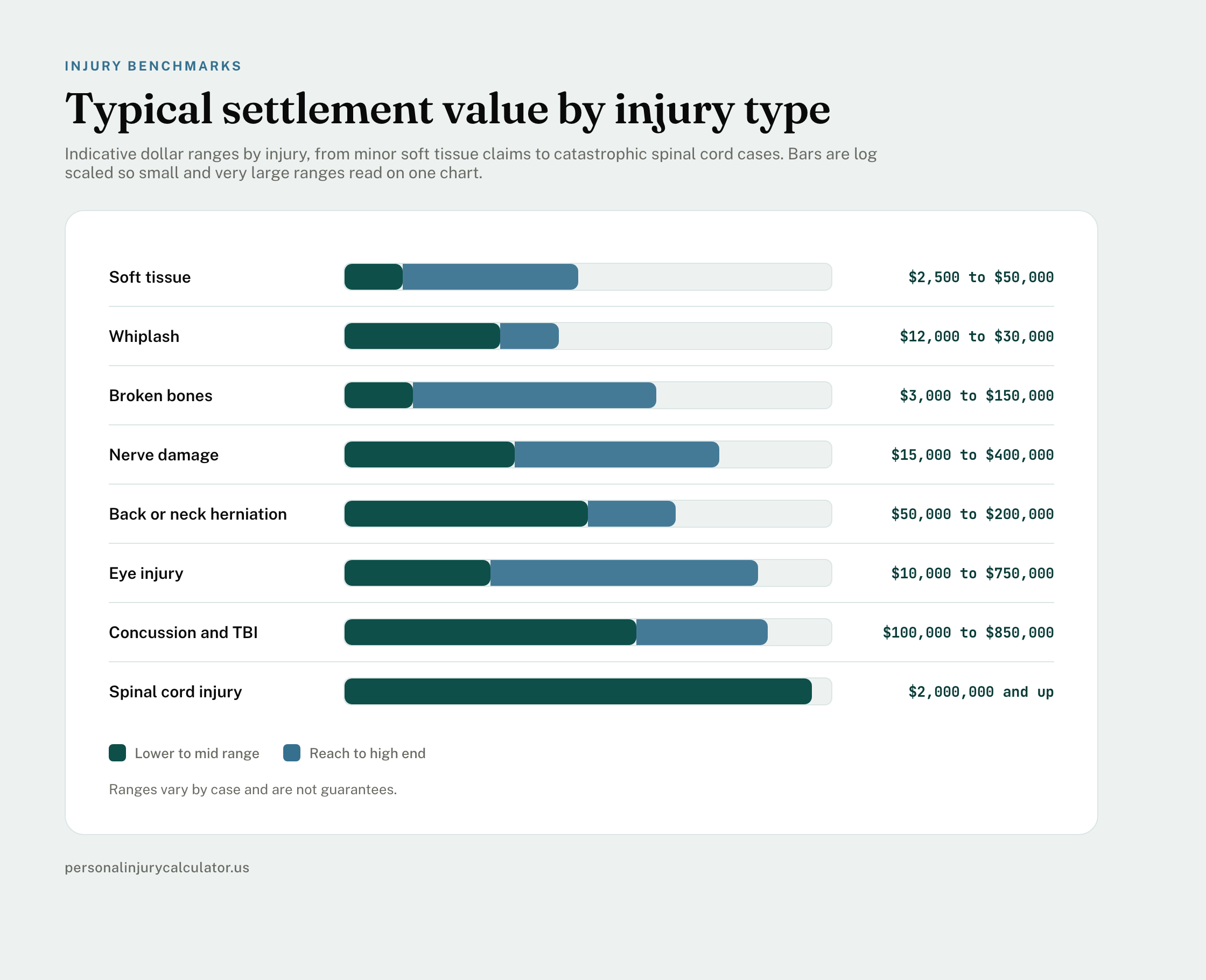
How severity tier and multiplier set the range
Adjusters do not price injuries one at a time. They sort them into severity bands and apply a multiplier to your economic damages, the bills and lost income you can actually document. This site uses five tiers, running from a multiplier of 1.5x at tier 1 to 5.0x at tier 5, which is the range bodily injury adjusters work within when setting a claim reserve.
The consequence is that the multiplier and your documented losses matter jointly, not separately. A tier 3 injury on $8,000 of bills and a tier 1 injury on $25,000 of bills can land in the same place. Raising the tier without raising the documented loss moves the number far less than people expect, which is why applying a multiplier to economic damages spends most of its length on the economic side.
The tier is a starting position, not a verdict. It is where the negotiation opens once liability is accepted.
Objective injuries settle higher than subjective ones
The single strongest predictor of where in a range a claim lands is whether the injury shows up on an image. A fracture on an X-ray, a herniation or a torn ACL on an MRI, or a documented nerve conduction deficit gives an adjuster something they cannot argue away, and it prices accordingly.
Soft tissue and whiplash claims sit at the bottom of the tiers for exactly the opposite reason. The pain is real and the imaging is often clean, which leaves the file resting on your own account of it and on the treatment record. That is also why gaps in treatment cost these claims more than they cost a fracture claim: with no objective finding, consistent treatment is the evidence.
At the top end, a spinal cord injury runs from roughly $2,000,000 to $8,000,000 in this dataset, not because the multiplier is three times a fracture multiplier, but because the underlying economic loss includes lifetime care and lost earning capacity rather than a course of physiotherapy.
What these ranges are, and what they are not
Each range on this page describes what claims of that injury class have typically resolved at, not what your claim is worth. Two people with the same diagnosis routinely settle years and six figures apart because of fault, venue, policy limits, and the quality of their medical record.
Policy limits in particular put a ceiling on the majority of claims that no valuation method can lift. A claim that prices at $180,000 against a $50,000 policy with no other recoverable defendant is, in practice, a $50,000 claim.
Use the tier to find the right starting range, then run your own bills and lost income through the calculator on any of these pages to see how your documented losses move it.
The deadline that ends the claim whatever it is worth
Every range on this page is theoretical until you file in time. The statute of limitations is the one deadline in an injury claim with no partial credit: a claim worth $400,000 the day before it expires is worth nothing the day after.
The general personal injury deadline runs from one year to six across the 50 states and DC. Twenty-five jurisdictions sit at two years and 17 at three, which is where most people's assumption comes from, but Kentucky and Tennessee allow only one. the state rules table carries the figure and the statute for each.
The general deadline is also not always the one that governs you. Medical malpractice, wrongful death, and any claim against a city, county or state body frequently run on separate and shorter clocks, and a claim against a government entity can require written notice within months rather than years. Check the state page before relying on the general number, and treat a suspected government defendant as urgent rather than routine.
By injury type, lowest to highest severity tier
Frequently asked questions
What are the main types of personal injury claim?
By injury rather than by accident, the classes that carry distinct valuation patterns are soft tissue and whiplash, neck and back injuries, broken bones, concussion and traumatic brain injury, nerve damage, eye injuries, scarring and disfigurement, and spinal cord injury. Each is graded on a severity tier from 1 to 5, and each has its own page here with a typical range and the drivers that move it.
Which injuries settle for the most?
Spinal cord injuries, by a wide margin. They sit at severity tier 5 with a 5.0x multiplier and typically resolve between $2,000,000 and $8,000,000, because the economic component includes lifetime attendant care and lost earning capacity rather than a finite course of treatment. Traumatic brain injury is the next highest, with an upper range near $850,000.
What does the severity tier mean?
It is the band an adjuster sorts your injury into before applying a multiplier to your documented losses. Tier 1 covers soft tissue and whiplash at 1.5x. Tier 3 covers the large middle group, including fractures, neck injuries, nerve damage and concussion, at 2.5x. Tier 5 is reserved for catastrophic permanent injury at 5.0x.
Why do soft tissue injuries settle so low?
Because there is usually nothing on an image to corroborate them. An adjuster pricing a whiplash claim has your account, your treatment record and little else, so the file is discounted for the risk that a jury would not credit it. The same claim with a documented herniation moves up a tier or more.
Does a pre-existing condition reduce what my injury is worth?
It changes what you are claiming rather than automatically reducing it. The claim becomes the aggravation of the existing condition, not the condition itself, which makes the comparison between your medical records before and after the incident the central evidence in the file. A well documented baseline helps this kind of claim considerably. A gap in records before the incident hurts it.