
Average Personal Injury Settlement: Why the Number Misleads
The average personal injury settlement for a car accident case in the United States is approximately $19,000, but that average tells you very little about any specific case. Averages get pulled upward by a handful of catastrophic outliers, so the median is usually a better central estimate. Severity is what drives value. Minor injuries such as sprains, whiplash, or minor soft-tissue damage commonly settle in the range of $5,000 to $25,000.
A widely used injury compensation chart groups minor settlements at roughly $3,000 to $25,000, moderate at $25,000 to $100,000, and severe at higher levels. Catastrophic injury and wrongful death cases carry the highest value, often limited mainly by the available insurance coverage. The way past the average is to build your own number, and then to subtract what reaches you after fees, because case value equals economic damages plus non-economic damages, adjusted for your share of fault and then reduced by attorney fees, case costs, and liens. This guide covers both halves: what the published averages are worth as orientation, and the step-by-step valuation that replaces them.
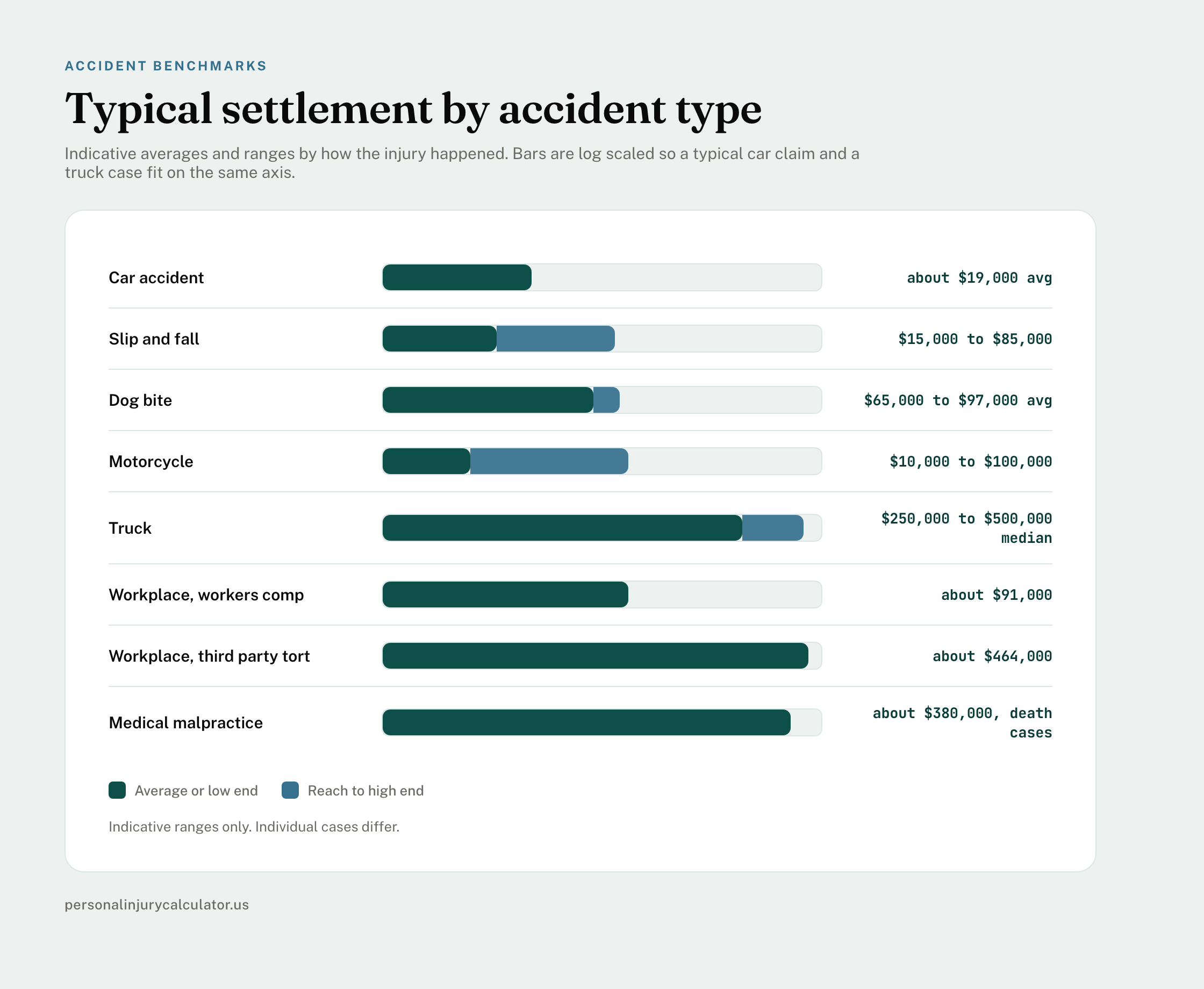
Why averages mislead
Start with the most-quoted figure. The average settlement for a personal injury car accident case in the United States is approximately $19,000. That single number gets repeated everywhere, and on its own it is close to useless for planning.
The problem is the shape of the data. A small number of catastrophic cases settle for millions, and those outliers drag the average far above what a typical claim resolves for. One paralysis case can lift the average for a thousand whiplash claims.
That is why the median is usually a better central estimate. The median is the middle case, the one where half settle for more and half for less, and it is far less sensitive to a few enormous outliers. The largest data study cited in this space makes exactly this point about average versus median.
So when you see an "average settlement" headline, read it as a rough reference point, not a forecast. Your case is not the average. It is your facts, your injuries, your state's law, and the insurance coverage available.
Ranges by injury severity
Severity is the strongest predictor of value, so ranges grouped by severity are more useful than any single average, and the settlement ranges by injury type break the same picture down injury by injury. A widely used injury compensation chart groups minor injury settlements at roughly $3,000 to $25,000, moderate injuries at $25,000 to $100,000, and severe injuries at higher levels.
Drilling into specific minor injuries, sprains, whiplash, and minor soft-tissue damage commonly settle in the range of $5,000 to $25,000. For whiplash specifically, an average payout with no permanent impairment runs roughly $12,000 to $30,000, while mild whiplash can settle for $2,500 to $10,000 and moderate whiplash with prolonged treatment for roughly $10,000 to $30,000.
Slip and fall numbers vary widely by state. One Texas guide reports a typical range of $15,000 to $85,000 with severe cases reaching $500,000 or more. A California guide reports averages of $30,000 to $60,000 with serious cases reaching $500,000 to $2,000,000 or more. These are self-reported law firm ranges and individual cases differ greatly.
Accident type shifts the band for its own reasons. The value of a pedestrian accident settlement turns on how badly an unprotected person was hurt and on whether they crossed legally, while a product liability claim can reach the manufacturer, distributor, and retailer in the chain of distribution rather than one driver's policy. Same buildup, different defendants and different injury profiles.
Catastrophic injury and wrongful death cases sit at the top, and their value is often limited mainly by the available insurance coverage rather than by the math of the injury. A death claim is not valued by multiplying bills at all: see the wrongful death settlement calculator.
A multi-million-dollar calculated value collects nothing beyond a small policy if the defendant has no assets, which is why coverage limits, not the severity of the harm, frequently decide what a serious case actually pays.
What actually drives your number
The factors that move a settlement are concrete, and you can influence several of them. Injury severity and permanence sit at the top. A permanent impairment is worth far more than an injury you fully recover from.
Documentation matters enormously. Consistent, gap-free medical records that tie your treatment to the accident strengthen the claim. Treatment gaps, where you stopped going to the doctor for weeks, give the insurer a reason to argue you healed or that something else caused the problem.
Liability clarity is the next lever. A rear-end crash with a clear at-fault driver supports a higher value than a disputed intersection collision where fault is shared, and rear end collision settlement covers what insurers still argue when fault is not in doubt. Your own share of fault can reduce or even bar your recovery, depending on your state's negligence rule.
Finally, insurance policy limits cap reality. Practitioner sources note pain and suffering can represent the largest portion of a serious settlement, sometimes 40% to 60% of the total in moderate to severe cases, but none of that matters past the available coverage. Age, pre-existing conditions, and claimant credibility round out the list.
Why the same injury settles for different amounts by state
Two people with identical injuries can walk away with very different settlements, and state law is a big reason. The clearest driver is the negligence rule that governs shared fault.
In a comparative negligence state, your recovery is reduced by your share of fault, and the arithmetic is exact: recovery equals the full damages times (1 minus your fault percentage). If you are 20% at fault on a $100,000 claim, you collect $80,000.
Pure comparative states let you recover even at high fault percentages, as the California fault rule does, while modified comparative states cut off recovery once your fault reaches the state's bar, either 50% as Georgia sets it or 51% in most of the rest.
A few states use the harsh pure contributory negligence rule, where any fault at all bars recovery entirely. Alabama, Maryland, North Carolina, Virginia, and the District of Columbia fall in this camp. In those places, an injury that settles handsomely elsewhere can settle for nothing if the insurer pins even 1% of the blame on you.
Insurance rules add another layer. No-fault states route minor injury claims through Personal Injury Protection first and only let you pursue pain and suffering against the at-fault driver once you meet a statutory injury threshold, whether that is Michigan's PIP system, the New York serious injury threshold, or Pennsylvania's limited tort option. That threshold alone can keep a minor claim from ever reaching a non-economic recovery.
Coverage limits finish the picture. The same severe injury collects far more where the at-fault driver carries high limits than where they carry a state-minimum policy and no assets. Geography, in short, is not a detail. It is one of the largest variables behind any settlement figure.
How a settlement figure actually gets built
Behind any settlement figure is a buildup, not a lookup. Case value starts with a simple equation: settlement value equals economic damages plus non-economic damages. Everything after that is refinement on top.
Economic damages are your objective, documented losses, the ones with receipts: past medical bills, future medical bills, past lost wages, future lost wages, and property damage. Non-economic damages are the subjective harms, mostly pain and suffering, that have no invoice and have to be estimated.
The economic pieces are documented. The pain-and-suffering piece is estimated, most often with the multiplier method, which multiplies economic damages by a factor of 1.5 to 5 by severity, or the per diem method, which assigns a daily rate.
Then the number gets adjusted. Your state's negligence rule can reduce the total by your share of fault. Attorney fees, case costs, and medical liens come out of the recovery before you net anything. A "take-home" figure is always lower than the headline.
So the honest version of the formula has four moving parts: add up the economic damages, estimate the non-economic damages, apply the fault rule, then subtract the deductions. Work through each one and you have a defensible range rather than a guess.
This is why no average can stand in for a real estimate. The same injury produces wildly different settlements depending on the wage loss, the documentation, the state, and the coverage. Use averages to sanity-check a range, then build the number from your own facts.
Add up the economic damages
Economic damages are the documented, "special" damages: past and future medical expenses, lost earnings, reduced earning capacity, and property damage. They are supported by receipts, bills, and pay stubs, which makes them the sturdy part of any claim.
Work a real illustration. Say your medical expenses are $45,000, your lost wages for 12 weeks off work are $18,000, and your projected future medical treatment is $10,000. Add them and you have $73,000 in economic damages.
Two pieces deserve care. Future medical costs require a projection, sometimes a formal medical cost projection or, in catastrophic cases, a full life care plan prepared by a certified planner and reduced to present value by an economist. And lost earning capacity, your reduced ability to earn going forward, usually needs a vocational expert, not just a pay stub.
A wrinkle on medical bills: providers rarely collect their full sticker charge, because insurers pay discounted rates. States split on whether you can recover the billed amount or only the paid amount, so the recoverable medical figure can itself be contested.
Estimate the non-economic damages
Non-economic damages, the general damages, cover pain and suffering, loss of enjoyment of life, emotional distress, and physical limitations. They often make up the largest portion of a serious settlement, sometimes 40% to 60% of the total in moderate to severe cases, though that is a practitioner estimate and not a legal rule.
There are two common methods to put a number on them. The multiplier method multiplies your economic damages by a factor of 1.5 to 5, set by severity. On the $73,000 economic base above, a moderate multiplier of 3 would produce $219,000 in pain and suffering.
The per diem method assigns a daily rate, often tied to your daily wage, and multiplies it by the days from injury to maximum medical improvement. A $200 daily rate over 365 days produces $73,000 in pain and suffering.
Neither method is law. They are estimating tools, and the figure they produce is a starting point for negotiation, not a guaranteed award. At trial, the jury sets the non-economic number.
What proof each piece requires
A number is only as strong as the evidence behind it, and each component of value is proven differently. Knowing what proof each piece needs tells you where your claim is solid and where it is exposed.
Past medical expenses require itemized bills, Explanation of Benefits statements showing who paid what, and the medical records tying treatment to the accident. To recover them, you generally have to show the expenses were both reasonable and necessary, and that they were incurred because of the defendant's negligence.
Lost wages are proven through employment and medical records that identify the time you missed, usually pay stubs compared against attendance records. Lost earning capacity, your reduced ability to earn going forward, is much harder and usually requires a vocational expert to assess what you could have earned and an economist to project and discount future losses to present value.
Future medical costs are proven by projection, not receipt. A lighter medical cost projection works for settlement, while catastrophic cases use a full life care plan from a certified planner, with an economist reducing the lifetime cost to present value. Pain and suffering leans on records of activity restrictions, photographs, a pain journal, and statements from people who saw the change in you.
Property damage runs on its own track. A totaled vehicle is valued at its Actual Cash Value, the local market value, while a repaired vehicle with an accident history can support a separate diminished value claim, and the property damage calculator works through both routes. The stronger and more consistent your documentation across all of these, the harder each number is to argue down.
From gross average to your net number
Even a perfectly accurate average describes a gross figure, not what lands in a bank account. Any tool that claims to estimate your "take-home" should show the gross first and then subtract down to a net, because the path from headline to bank balance cuts the number down, and understanding that gap keeps expectations honest.
Attorney fees come out first for represented claimants. The standard contingency fee runs about 33% to 40% of the recovery, typically around one-third for cases that settle before a lawsuit and up to 40% for cases that go through litigation. On a $30,000 settlement, a one-third fee is $10,000 before anything else.
Liens follow. When health insurance, Medicare, Medicaid, or an ERISA plan paid for your accident treatment, the payer often has a right to be reimbursed out of the settlement. Some liens are negotiable, but Medicare and ERISA plans can demand full repayment, and ignoring them can freeze the funds.
Case costs and certain taxes round it out. Filing fees, expert fees, and records costs are deducted, and while compensatory damages for physical injury are generally not taxed, punitive damages, interest, and emotional distress not stemming from a physical injury can be. Each piece shaves the gross.
So when you compare your situation to an "average," compare gross to gross. A $19,000 average is a gross figure, and your net after fees, liens, and costs will be lower. Build your expectation around the net, and the averages become a useful reference instead of a misleading promise.
It also helps to know roughly how the gross splits. In moderate to severe cases, practitioner sources note that pain and suffering can run 40% to 60% of the total, which means the economic damages, your bills and lost wages, are often less than half the headline.
That is a practitioner estimate rather than a legal rule, but it explains why two claims with similar medical bills can land far apart: the difference is usually in the non-economic piece, where severity and documentation do the heavy lifting. When you see an average, picture it as a blend of documented losses and an estimated pain-and-suffering figure, not a single fixed payout.
A full worked example, gross to net
Averages make more sense once you have watched a buildup run end to end, so here is the whole sequence on one set of facts. Start with the economic base from earlier: $45,000 in medical expenses, plus $18,000 in lost wages over 12 weeks off work, plus $10,000 in projected future medical treatment, which totals $73,000 in economic damages.
Now price the non-economic side twice, because the two standard methods do not agree. The multiplier method at a moderate factor of 3 gives 3 times $73,000, or $219,000. The per diem method at a $200 daily rate over 365 days gives $73,000. Same injuries, same bills, and the two estimates sit $146,000 apart before anything else happens.
Take the multiplier path first. Gross claim value is the economic base plus the non-economic estimate: $73,000 plus $219,000 equals $292,000. Notice what that mix implies. Pain and suffering is $219,000 of $292,000, which is 75% of the total, well above the 40% to 60% share practitioner sources describe for moderate to severe cases.
That is a signal the multiplier of 3 is aggressive on these facts, and an adjuster will say so. The per diem figure, by contrast, is exactly 50% of its own $146,000 gross, which sits inside the usual band.
Apply the fault rule next. Assume a comparative negligence state and a 20% share of fault. Recovery equals the full damages times (1 minus 0.20), so $292,000 times 0.80 equals $233,600. Put another way, that fault finding costs $58,400, which is why the fault percentage is usually the most heavily argued number in the file.
Then subtract what comes out. The standard contingency fee runs about 33% to 40%, so a one-third fee on a case that settles before a lawsuit takes $77,866.67 of the $233,600 and leaves $155,733.33. Case costs and a medical lien follow.
Neither has a typical published figure, so assume, purely to complete the illustration, $6,000 in case costs (filing fees, records, expert charges) and a $12,000 lien from the health plan that paid for treatment. Those last two are placeholders chosen to keep the arithmetic visible, not data, and yours will differ.
That leaves $155,733.33 minus $6,000 minus $12,000, which is $137,733.33 net. Against a $292,000 headline, the claimant keeps just over 47% of the gross. Run the per diem path through the identical steps and it starts at $146,000 gross, falls to $116,800 after the 20% fault reduction, loses $38,933.33 to the one-third fee, and finishes at $59,866.67 net after the same $6,000 in costs and $12,000 lien. Two defensible methods, one set of facts, and close to $77,900 between the take-home figures.
Set that against the $19,000 average and the point of this guide lands. A single moderate case with a $73,000 documented base can net anywhere from roughly $60,000 to roughly $138,000 depending only on which estimating method survives negotiation, before anyone argues about severity, documentation, or coverage limits. The average is not wrong. It is answering a different question than the one you are asking.
Common mistakes that shrink the number
Several avoidable mistakes quietly lower settlements, and most trace back to evidence and timing rather than the math. The first is treatment gaps. When you stop seeing a doctor for weeks, the insurer argues you recovered or that something else caused the problem, which weakens both the economic base and the pain-and-suffering multiplier.
Settling too early is another. A common caution is not to settle until your treatment is complete, so the full scope of your injuries is known. Accept a number before you learn you need surgery, and you cannot reopen the claim to recover for it.
Ignoring liens creates a different problem. Medical liens from health insurers, Medicare, Medicaid, or an ERISA plan must be identified and resolved out of the settlement, and ignoring them can freeze your funds and expose you to repayment liability. They do not reduce your gross claim, but they cut deep into your net if you do not plan for them.
Overlooking future and capacity losses leaves money behind. Many claimants document the bills they have already paid but forget the future medical care and the reduced earning capacity that often dwarf the immediate costs in a serious case. Those require expert support, but they are real components of value.
Finally, misjudging fault distorts the whole estimate. Your share of fault reduces or, in pure contributory states, can bar recovery entirely. Assuming you have no fault when the insurer plans to argue you have some is how a claimant ends up surprised by a low offer. Build the number with the fault rule in mind from the start.
How to use an average responsibly
An average is a sanity check, nothing more. If your minor soft-tissue claim is being offered far below the typical $5,000 to $25,000 range with no good reason, that tells you something. If a catastrophic claim is being valued like a minor one, that tells you something too.
Be skeptical of the source. Most published "average settlement" figures come from law firm marketing pages, which are self-interested and not verified data. Government and large-study sources carry more weight, and even they caution that medians beat averages.
Remember what averages hide. They flatten the differences in severity, state law, liability, and coverage that actually determine your number. Two claimants with identical injuries can settle for very different amounts based on which state they are in and how much insurance the other driver carried.
The honest takeaway is that there is no single right number, only a range you can defend with documentation. Run your own figures through a personal injury calculator, compare the output to the cited severity ranges, and treat any clean national average as the rough orientation it is.
An average can flag when an offer is wildly off, but it can never stand in for the case-specific buildup that determines what your claim is actually worth.
Putting it together: from average to your own number
Run the full sequence end to end. Sum the economic damages. Estimate the non-economic damages with the multiplier or per diem method. Add them for a gross claim value. Apply your state's fault rule. Subtract the contingency fee, case costs, and liens for a net estimate, and flag any taxable elements.
Treat the output as a range, not a verdict. Actual case value depends on facts, evidence, jurisdiction, insurance limits, and negotiation, and a real number requires a licensed attorney to evaluate your specific situation.
These are estimates based on typical industry methods, not a prediction or guarantee of any outcome. This is not legal or tax advice. For a serious or contested case, the value of professional evaluation usually outweighs the cost.
The point of the framework is control. When you understand each step, you can see exactly where an offer is light, whether the insurer underweighted your future care, lowballed the multiplier, or overstated your share of fault, and respond with documentation rather than a guess.
That is the real replacement for an average: not a better headline number, but a number of your own that you can defend line by line.
Frequently asked questions
What is the average personal injury settlement?
The average car accident personal injury settlement in the United States is approximately $19,000, but that average is skewed by catastrophic outliers and says little about any specific case. The median is usually a more honest central estimate.
What is the average settlement for minor injuries?
Minor injuries such as sprains, whiplash, and minor soft-tissue damage commonly settle in the range of $5,000 to $25,000. A widely used compensation chart groups minor settlements at roughly $3,000 to $25,000.
Why is the median better than the average?
Because a few catastrophic cases that settle for millions pull the average far above a typical claim. The median, the middle case, is far less sensitive to those outliers and gives a more realistic central estimate.
Are published average settlement figures reliable?
Treat them cautiously. Many come from law firm marketing pages, which are self-reported and not verified data. They are useful as indicative ranges to sanity-check a number, not as predictions for your case.
Why do settlements for the same injury vary so much?
Because value depends on wage loss, documentation quality, liability clarity, your share of fault, your state's negligence rule, and the available insurance coverage. Two identical injuries can settle for very different amounts based on those factors.
How do I calculate what my personal injury case is worth?
Add your economic damages (medical bills, lost wages, future care, property damage), estimate non-economic damages with the multiplier or per diem method, add them for a gross value, reduce by your share of fault under your state's rule, then subtract attorney fees, case costs, and liens for a net estimate.
What share of a settlement is pain and suffering?
Practitioner sources note pain and suffering can be the largest portion of a serious settlement, sometimes 40% to 60% of the total in moderate to severe cases. That is an estimate, not a legal rule, and it varies heavily by case.
Does my fault reduce what my case is worth?
Usually yes. In comparative negligence states, your recovery drops by your fault percentage, so full damages times (1 minus your fault share), and modified states bar recovery once you hit 50% or 51% fault. In the few pure contributory negligence jurisdictions, any fault at all can bar recovery entirely.
Why is my take-home less than the settlement amount?
Because attorney fees of roughly 33% to 40%, case costs, and medical liens come out of the recovery first, and certain portions like punitive damages and interest can be taxable. The net you keep is always lower than the gross headline figure.
Can a calculator tell me my exact case value?
No. A calculator gives an estimated range based on typical industry methods. Actual value depends on facts, evidence, jurisdiction, insurance limits, and negotiation, which only a licensed attorney in your state can fully evaluate. This is not legal advice.

About the editorial team
The PersonalInjuryCalculator.us editorial team documents how US insurance carriers value personal-injury claims and turns that into plain-English calculators and explainers. Every dollar range, multiplier, filing deadline, and damages cap published here is traced back to a named source. The team is not a law firm and includes no attorneys, so nothing on this site is legal advice. Speak with a licensed attorney in your state for serious or contested cases.
Sources
- Miller and Zois, settlement value of your claim Industry estimate
- CHG Lawyers, injury compensation chart Industry estimate
- Miley Legal, neck and back injury settlement amounts Industry estimate
- Steven M. Sweat, multiplier vs per diem method Industry estimate
- EvenUp Law, calculate settlement value Industry estimate
- Johnson Law, settlement valuation guide Industry estimate
- Justia, comparative and contributory negligence 50-state survey Industry estimate
- Mayfield Law Firm, contingency fee percentages Industry estimate
Sources marked Industry estimate are published by law firms or commercial legal publishers. No government body reports what personal injury claims actually settle for, so figures of that kind come from the market rather than from official data. Legal rules on this site trace to statutes and government publishers.