
Comparative Negligence: How Your Fault Share Reduces a Settlement
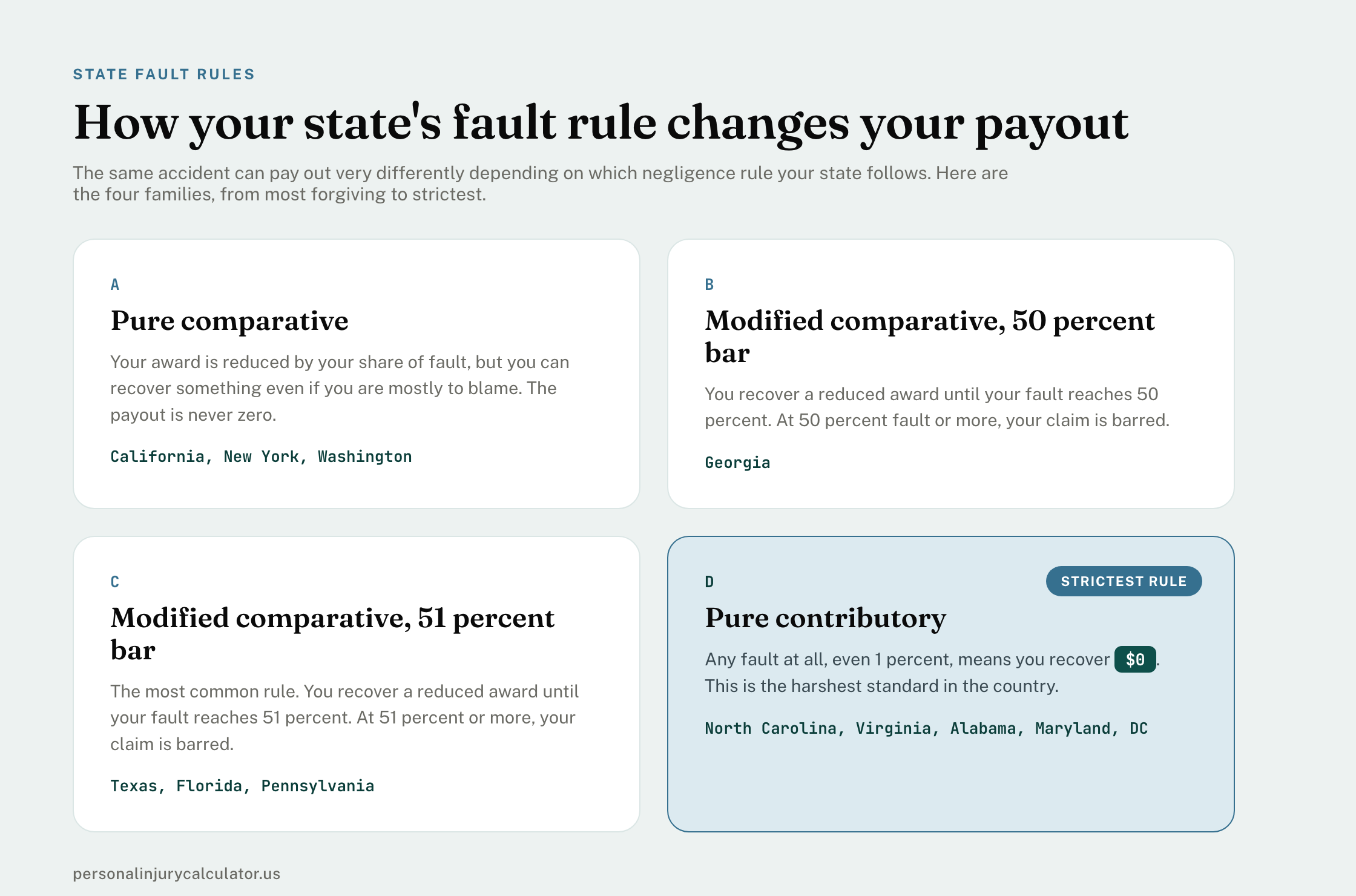
Comparative negligence is the rule that reduces your injury award by your own percentage of fault. If a jury or an adjuster decides you were 20% to blame for a crash valued at $50,000, comparative negligence drops your recovery to $40,000. There are two main forms. Pure comparative negligence (a rule that lets you recover even if you are 99% at fault, with the award cut by your share) applies in states like California, New York, and Washington.
Modified comparative negligence (a rule that bars recovery once your fault hits a set threshold) applies in over 30 states and comes in two flavors: a 50% bar and a 51% bar. The difference between those two is the single most expensive percentage point in personal injury law. This guide walks through each rule, shows the math, and explains why your state matters more than almost any other input.
What comparative negligence actually does to the number
Comparative negligence is a discount, not an on and off switch. You start with the full value of the claim, then subtract your share of the blame. The formula is simple. Recovery equals full damages multiplied by (1 minus your fault percentage).
Here is the math on a real-feeling claim. Say your damages add up to $80,000: $30,000 in medical bills, $15,000 in lost wages, and $35,000 estimated for pain and suffering. If you are found 30% at fault, you multiply $80,000 by 0.70. Your recovery is $56,000. The other side keeps the $24,000 that maps to your share.
This is why an adjuster fights so hard over fault percentage. Every 10 points of fault they pin on you erases 10% of the entire claim. On an $80,000 claim, talking your fault up from 10% to 30% saves the insurer $16,000. That is not a rounding error. It is often the whole point of the early phone calls.
The doctrine is state specific, and the categories are well documented. The Justia 50 state survey lays out the three main approaches that decide how fault changes your recovery.
Pure comparative negligence: recovery even at 99% fault
Pure comparative negligence is the most plaintiff-friendly rule. You can recover damages reduced by your own percentage of fault, no matter how high that percentage climbs. Even a plaintiff found 99% at fault recovers the remaining 1%.
An example shows how far this goes. On a $100,000 claim where you are 90% at fault, you still recover $10,000. In a modified comparative state, that same 90% fault share would bar you entirely. The rule itself is the difference between $10,000 and nothing.
States that use pure comparative negligence include Alaska, Arizona, California, Kentucky, Mississippi, Missouri, New Mexico, Rhode Island, and Washington. California reached this rule through Li v. Yellow Cab Co. (1975). It is the rule behind the Arizona fault rule and the Washington fault rule alike, where a claimant carrying most of the blame still collects the remainder instead of being cut off.
Two states left the list recently. Louisiana moved to a 51% bar on January 1, 2026 under Acts 2025 No. 15. New York still applies pure comparative to non-auto claims under CPLR 1411(a), but added CPLR 1411(b) effective May 26, 2026, which bars recovery in motor-vehicle actions once your fault is greater than the defendants' combined fault.
A couple of states add a twist. Michigan's split fault rule uses pure comparative for economic damages (medical bills, lost wages) but switches to a modified 51% bar for non-economic damages (pain and suffering). So a badly at-fault Michigan plaintiff can recover medical costs reduced by fault while losing pain-and-suffering money entirely. The category of damages, not just the fault number, controls the result there.
Modified comparative negligence: the 50% bar vs the 51% bar
Most states use modified comparative negligence. You recover damages reduced by your fault, but only if your fault stays below the state bar. Once you cross the bar, you recover nothing. There are two bar thresholds, and the one-point gap between them decides whole cases.
The 50% bar rule stops you at 50% or more. A plaintiff found exactly 50% at fault recovers nothing. To recover, you must be 49% or less at fault. States using the 50% bar include Arkansas, Colorado, Georgia, Idaho, Kansas, Maine, Nebraska, North Dakota, Tennessee, and Utah. Georgia's 50% bar is codified at O.C.G.A. 51-12-33(g), which says a plaintiff gets no damages if 50% or more responsible.
The 51% bar rule is one point more forgiving. You may not recover only if you are assigned 51% or more of the fault. A plaintiff found exactly 50% at fault still recovers, just cut in half. States using the 51% bar include Connecticut, Delaware, Florida (since 2023, except medical malpractice), Hawaii, Illinois, Indiana, Iowa, Massachusetts, Minnesota, Montana, Nevada, New Hampshire, New Jersey, Ohio, Oklahoma, Oregon, Pennsylvania, South Carolina, Texas, Vermont, West Virginia, Wisconsin, and Wyoming.
Cornell's Wex definition states the 51% rule in plain terms. The Illinois fault rule and the Texas fault rule both work this way, so a claimant found exactly half to blame in either state still collects half the claim, and so does Indiana's version of the 51 percent bar, which is unusual only in leaving medical malpractice and government claims outside the Comparative Fault Act on contributory negligence.
Why does this one point matter so much? Picture a 50-50 crash where each driver shares the blame equally. In a 51% bar state, the plaintiff recovers half their damages. In a 50% bar state, the same plaintiff recovers zero. Same facts, same fault split, opposite financial outcome. That is the entire reason fault disputes near the 50% line get fought so hard.
The state map keeps changing
Negligence rules are not frozen. Legislatures rewrite them, and courts reshape them. Florida is the clearest recent example. Until 2023, Florida was a pure comparative state. Then HB 837, signed in March 2023, switched it to a modified comparative 51% bar (codified at section 768.81), while keeping pure comparative for medical malpractice.
The same Florida crash in 2022 and in 2024 can settle for very different numbers, which is why Florida's current fault rule is worth checking before you put a value on a claim there.
South Dakota does not fit any of the three boxes. It uses a unique "slight negligence" model that compares whether your fault was slight against the defendant's. That is a fourth approach, and it shows why a national rule of thumb fails.
The practical takeaway for your own claim: confirm your state's current rule against the statute, not against an old article. The Florida shift proves how fast a "settled" answer can go stale. A calculator or guide should let you pick your state and should cite the live statute, because that one variable can swing your recovery by tens of thousands of dollars.
How adjusters use fault to lower offers
On the carrier side, fault is the lever adjusters reach for first. Liability is rarely 100-0. Even in a clear rear-end crash, an adjuster may argue you stopped short or had a brake light out. Each argument is an attempt to move your fault percentage up, because every point shrinks the payout.
Documentation is your counterweight. A police report assigning fault to the other driver, photos of the damage and the scene, and clear medical records all push your fault number down. When an adjuster floats a fault percentage, ask them to justify it in specifics.
Take notes, then reply in writing addressing each point. That is the same discipline Nolo recommends for the offer itself, and it applies just as much to fault.
Remember that fault is negotiated, not handed down from a judge in most cases. Only about 4% to 5% of injury cases reach a trial, which means the fault percentage in your case is almost always a number two parties argued over and agreed on, not a jury finding. That gives you room to push back with evidence.
If fault is genuinely contested, especially near the bar threshold in your state, this is where a lawyer earns the contingency fee. A few points of fault can be the difference between a full recovery and zero in a modified comparative state.
Frequently asked questions
What is the difference between the 50% bar and the 51% bar?
In a 50% bar state, you recover nothing if you are 50% or more at fault, so you must be 49% or less to recover. In a 51% bar state, you still recover at exactly 50% at fault and are barred only at 51% or more. The single point matters most in a 50-50 fault split, where one rule pays half and the other pays zero.
Can I still recover if I was mostly at fault?
It depends on your state. In a pure comparative negligence state, you can recover even at 99% fault, just reduced to 1% of the claim. In a modified comparative state, you are barred once you hit 50% or 51% depending on the bar. In a pure contributory state, any fault at all bars you entirely.
How does comparative negligence affect my settlement amount?
It reduces your recovery by your fault percentage. Full damages multiplied by (1 minus your fault share) gives your reduced amount. A 30% fault finding on a $80,000 claim leaves $56,000, assuming your state has no bar that stops you first.
Which states use pure comparative negligence?
Pure comparative states include Alaska, Arizona, California, Kentucky, Mississippi, Missouri, New Mexico, Rhode Island, and Washington. Check the date on any list you read: Louisiana moved to a 51% bar on January 1, 2026, and the New York fault rule picked up a 51% bar for motor-vehicle claims on May 26, 2026 while keeping pure comparative for everything else. Michigan is a hybrid that uses pure comparative for economic damages and a 51% bar for non-economic damages.
Who decides my fault percentage?
In a settlement, you and the adjuster negotiate it based on the police report, photos, witness statements, and the medical records. If the case goes to trial, the jury assigns the percentage. Because only about 4% to 5% of cases reach a trial, the fault number is usually a negotiated figure, not a jury finding.
Did any state recently change its negligence rule?
Yes. Florida switched from pure comparative to a modified comparative 51% bar in March 2023 under HB 837, codified at section 768.81, while keeping pure comparative for medical malpractice. Always confirm your state's current rule against the live statute.

About the editorial team
The PersonalInjuryCalculator.us editorial team documents how US insurance carriers value personal-injury claims and turns that into plain-English calculators and explainers. Every dollar range, multiplier, filing deadline, and damages cap published here is traced back to a named source. The team is not a law firm and includes no attorneys, so nothing on this site is legal advice. Speak with a licensed attorney in your state for serious or contested cases.
Sources
- Justia, Comparative and Contributory Negligence Laws: 50 State Survey Industry estimate
- Cornell Legal Information Institute, comparative negligence (Wex) Academic
- New York CPLR 1411 (pure comparative, with a 51% bar for motor-vehicle claims since May 2026) Official
- Georgia O.C.G.A. 51-12-33 (50% bar) Industry estimate
- American Bar Association, Florida tort reform (HB 837) Industry estimate
Sources marked Industry estimate are published by law firms or commercial legal publishers. No government body reports what personal injury claims actually settle for, so figures of that kind come from the market rather than from official data. Legal rules on this site trace to statutes and government publishers.