
The Multiplier Method: How Personal Injury Claims Price Pain and Suffering
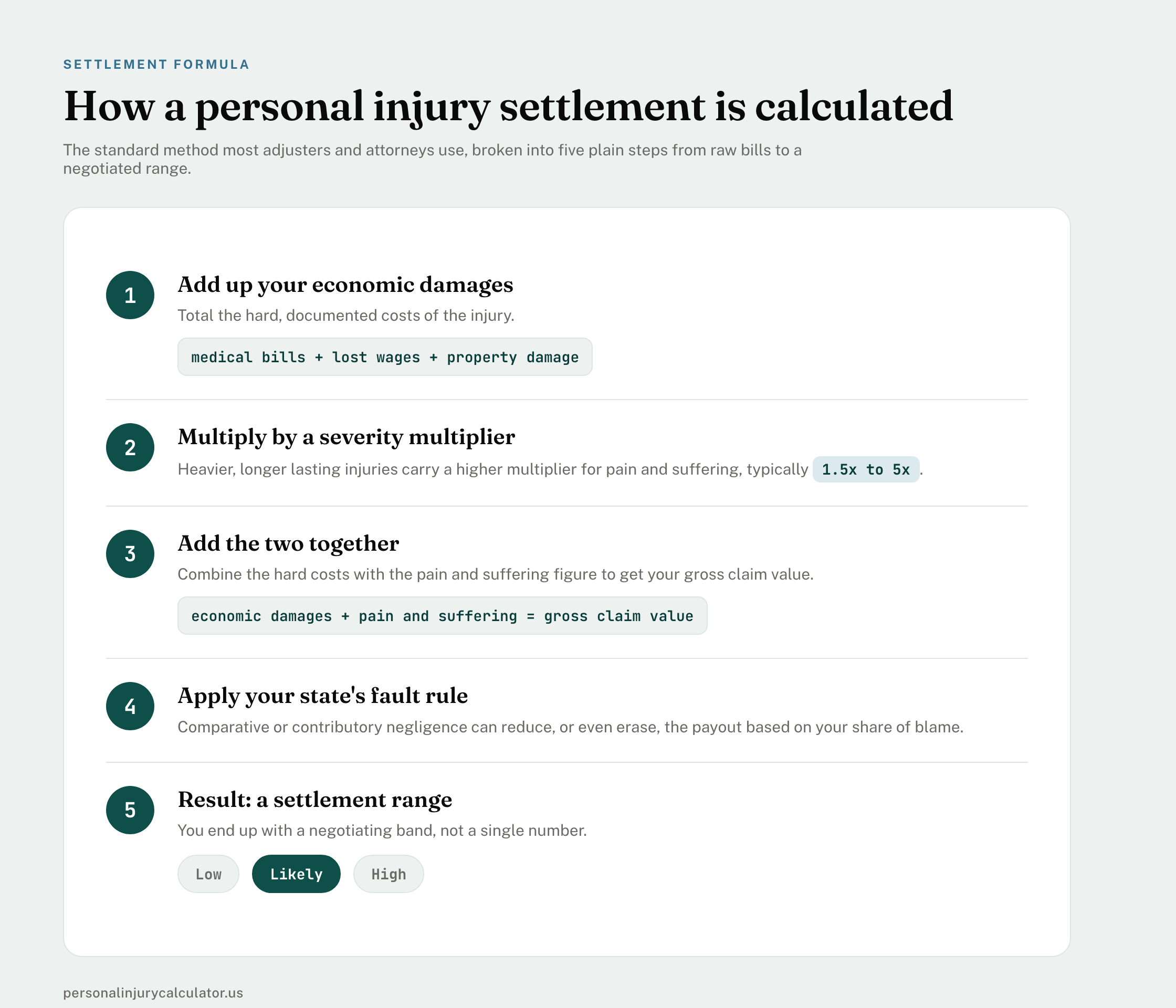
Pain and suffering has no receipt, so the industry uses one of two methods to put a number on it. The multiplier method takes your economic damages, the documented medical bills plus lost wages, multiplies that sum by a factor of usually 1.5 to 5 depending on severity, and adds the result back to reach a total claim value.
The per diem method works from time instead, assigning a daily dollar rate, often tied to your daily wage, and multiplying it by the days you are in pain, from injury until you reach maximum medical improvement. Here is one case run both ways. Take $50,000 in medical expenses plus $10,000 in lost wages, which is $60,000 in economic damages.
A multiplier of 3 values pain and suffering at $180,000 and the claim at $240,000. A $200 daily rate over 365 days values it at $73,000 and the claim at $133,000. Neither figure is law, and the gap between them is where the negotiation happens.
What the multiplier method actually does
Medical bills and lost wages are easy: you add them up. Pain and suffering, the physical and mental toll of the injury, has no invoice. The multiplier method solves that by tying the intangible loss to the tangible one.
You total your economic damages, mostly medical special damages plus lost wages, multiply that by a factor, and add the result back. Written as a formula, total claim value equals economic damages plus (economic damages times the multiplier), which is the same as economic damages times (1 plus the multiplier).
The logic is that bigger medical bills tend to signal a more serious injury, and a more serious injury tends to mean more suffering. It is a rough proxy, not a perfect one. But it is the most common technique insurers and attorneys use to estimate non-economic damages, so it tells you how an adjuster is probably thinking about your file.
How the factor gets chosen
The multiplier usually falls between 1.5 and 5, set by the severity of the injuries, and the personal injury types covered here show where each one typically sits in that band. That range is consistent across legal references, including FindLaw and the Sacramento County Public Law Library.
Practitioners group it by tier. Minor injuries that heal completely within weeks, like soft-tissue damage or minor fractures, get 1.5 to 2. Moderate injuries, like herniated discs, significant scarring, or anything requiring surgery, get 2.5 to 3.5, which is the band a surgical eye injury with partial recovery tends to sit in.
Catastrophic injuries, like permanent disability, traumatic brain injury, spinal cord damage, or life-altering disfigurement, get 4 to 5 or beyond, and that is why a motorcycle accident settlement so often lands at the top of the range: a rider has no frame, no airbags, and no crumple zone, so the same collision produces far worse injuries.
Inside those tiers, long-term prognosis and permanence move the number, and so does the quality of your evidence, which the sections below take apart.
The key point is that the factor is a negotiation point, not a fixed rule. No statute tells anyone to use 3 instead of 2.5, and no insurer publishes an internal formula either, which is why there is no State Farm pain and suffering calculator despite what the search results promise. Two adjusters looking at the same file can land on different numbers, which is exactly why the method gets criticized as arbitrary.
A worked example: the multiplier method
Run the numbers on a moderate case. Say you have $50,000 in medical expenses and $10,000 in lost wages, so your economic damages are $60,000.
The injury required surgery but you are expected to recover, so the adjuster reaches for a multiplier of 3. Pain and suffering values at $60,000 times 3, which is $180,000. Add that back to the economic damages and the total claim value is $240,000.
Now see how sensitive the total is to the factor. Keep the same $60,000 base. At a multiplier of 1.5 the total is $150,000. At 5 it is $360,000. Same injury costs, very different headline numbers, driven entirely by a single argued figure. That spread is why the multiplier is where most of the negotiation energy goes.
What evidence raises or lowers the factor
Because the multiplier is argued rather than calculated, evidence is what moves it, and medical records are the spine of the argument. Records noting activity restrictions, treatment bills, mental health visit bills, prescription records, and the imaging that confirms an injury all push the factor up. Objective findings, like a herniated disc on an MRI, carry more weight than complaints alone, because the insurer cannot wave them away.
Personal evidence helps too: photographs of injuries, a pain journal, employer documentation of lost time, and before-and-after statements from family or friends. What lowers the factor is just as predictable. Treatment gaps suggest you recovered or were barely hurt, and inconsistencies, missed appointments, and a thin paper trail give the insurer reasons to argue down.
Two factors sit outside your control. Permanence is the big one: lasting effects support a multiplier near the top of the range, while a full recovery argues for the bottom. Clarity of fault matters too, because obvious liability supports a fuller valuation.
Keep the file intact either way, because the same records do double duty under the per diem method: what justifies a high multiplier justifies a high daily rate and a long day count.
Where the multiplier method breaks down
The method has real weaknesses. The biggest is that it is arbitrary: two attorneys can pick different multipliers for identical facts, and the method ignores how vulnerable any particular claimant is to a given injury.
It also leans on medical bills as the proxy for suffering, which distorts things. A serious injury treated cheaply, or one where you toughed it out with less care, produces a low economic base and therefore a low pain-and-suffering figure even when the suffering was real.
The output is only an estimate, and it can be capped hard by the at-fault party's insurance policy limits, a ceiling the negotiation section returns to.
In no-fault states such as Florida and New Jersey, pain and suffering is not available at all under a Personal Injury Protection or MedPay claim. You have to meet your state's injury threshold first, so the multiplier only enters the picture once that threshold is cleared.
What the per diem method is
Per diem is Latin for per day, and the idea is that literal. You pick a dollar value for one day of living with the injury, count the days you actually deal with it, and multiply the two.
The clock usually starts on the date of the accident and runs until you reach maximum medical improvement, the point where your condition has stabilized and is not expected to get meaningfully better. Adjusters shorten that to MMI.
Written as a formula, per diem pain and suffering equals the daily rate times the recovery days, and total claim value equals your economic damages plus that figure. Notice what is missing: your medical bills appear nowhere in the pain-and-suffering half of it. That is the structural difference from the multiplier.
The strength of the method is that it produces a number you can explain day by day: you point to a calendar and a rate instead of arguing about an abstract multiplier.
Setting the daily rate
The hardest part is choosing the rate, because nothing fixes it. The most common approach ties it to your actual daily earnings, on the reasoning that a day spent in pain deserves compensation comparable to a day of work.
The reported practical range is roughly $100 to $500 per day by severity, and one practitioner source gives around $200 per day as reasonable for a moderate injury. In numbers, someone earning $50,000 annually makes about $137 per day, which can serve as the baseline. A claimant who earns more justifies a higher rate; someone who earns less anchors lower.
Because the rate is a starting point and not a rule, expect the other side to argue it down, saying your daily wage overstates your suffering or that the rate should drop as you recovered. Setting an appropriate rate is genuinely difficult, and that difficulty is the method's main criticism. A rate tied to documented earnings is far easier to defend than one pulled from the air.
Counting the days correctly
The day count is half the formula, so getting it right matters as much as the rate. It runs from the accident date until you reach maximum medical improvement, and that end date gets contested. The insurer may argue you reached it earlier, which shrinks both the count and the figure.
Your medical records are the referee: a doctor's note marking when you plateaued, or a discharge from active treatment, anchors the end date far better than your own say-so.
Not every day is necessarily worth the same rate either. Some attorneys taper the rate as recovery progresses, charging full freight for the acute phase and less for the tail end when symptoms had eased. A tapered count can be more credible to an adjuster than a flat rate across a long recovery, because it matches how suffering usually fades.
One discipline ties it together: do not lock the count until treatment is complete, or you risk undercounting if recovery drags and having to explain why you are still in care after claiming you healed.
A worked example: the per diem method
Run the same case through the daily-rate approach so the two are comparable. Keep the economic base from the multiplier example: $50,000 in medical expenses plus $10,000 in lost wages, which is $60,000.
You earn $50,000 a year, about $137 per day. You and your attorney settle on a round $200 daily rate, slightly above your wage because the injury was painful and limited your daily life. Recovery from injury to maximum medical improvement took a full year, so you count 365 days. Multiply: $200 times 365 is $73,000 in pain and suffering.
Add the economic damages back and the total claim value is $60,000 plus $73,000, or $133,000. Change either input and the figure moves directly with it, which is why both get negotiated. Tie the rate strictly to the wage instead, at about $137 per day, and the same 365 days produce roughly $50,000 and a claim near $110,000.
When per diem fits and when it does not
Per diem works best for moderate injuries with a clear, documentable recovery period, with a clean start date and a clean end date supported by medical records. A broken arm that healed over four months is a good candidate: the calendar is obvious and the suffering had a defined end.
It breaks down for permanent or catastrophic injuries. With no end date because the impairment is for life, the day count becomes a guess about your remaining lifespan, and the total balloons into figures no insurer will treat as serious.
It struggles to scale well short of permanence too. A $300 daily rate over three years is more than $300,000 in pain and suffering, and an adjuster will push back hard on a number that large built from a daily rate, even when the arithmetic is sound.
Insurers respond to a per diem demand by reframing. They may switch to the multiplier if it produces a lower number on your facts, or split the difference. Because both methods are negotiation tools rather than rules, the side with the better-documented inputs wins the framing.
Multiplier versus per diem, head to head
The two methods answer the same question from opposite directions. The multiplier ties pain and suffering to money already spent, so it scales with the cost of care. Per diem ties it to time, so it scales with the length of recovery. Run both on one file and they rarely agree, which is the most useful thing to know about them.
Use the case from the two worked examples: $60,000 in economic damages, a multiplier of 3, and a $200 daily rate over 365 days. The multiplier produces $180,000 in pain and suffering and a $240,000 claim. Per diem produces $73,000 and a $133,000 claim. Same injury, same bills, same year of recovery, and $107,000 between the two figures.
Working backward makes that gap easier to argue about. The $73,000 per diem figure is about 1.2 times the $60,000 economic base, below the 1.5 floor of the usual multiplier range. Put the other way, matching the multiplier's $180,000 across 365 days would take a daily rate of about $493, at the very top of the reported $100 to $500 band.
Both readings say the same thing: on these facts the bills are large relative to the time lost, since $50,000 of the $60,000 base is treatment and the $10,000 in lost wages is only about 73 days of a $50,000 salary.
That points to the general rule. The multiplier produces the higher number when medical bills are large relative to the recovery window, the usual shape of a surgical or catastrophic case. Per diem produces the higher number when the bills are modest but the recovery is long and well documented, because a per diem figure does not shrink just because you were treated cheaply.
Acceptance is not symmetrical either. The multiplier is the most common technique insurers and attorneys use, so it is probably the frame the adjuster is already working in. Per diem is the challenger, and its appeal is concreteness: for an adjuster or a juror, a number you can explain day by day often feels more grounded than a factor pulled from a range. But that appeal survives only at moderate totals, because a daily rate stretched across years produces a figure the adjuster will not engage with.
That is why running both is worth the effort. One method gives you a single figure the other side attacks from one direction. Two give you a band, an upper anchor and a lower floor, both built from your own records, and a band is what you want walking into a negotiation.
Using both methods as a negotiation tool
Knowing the methods lets you read an offer rather than react to it. Run your own figures through a personal injury calculator first, so you come to the call with a range instead of a blank page. Then subtract your documented economic damages from the total, and what remains is the implied pain-and-suffering figure.
Divide that by your economic damages and you have the multiplier the adjuster effectively used; divide it by your day count instead and you have the daily rate they effectively paid. If your surgical injury is being valued at a 1.5 multiplier, the offer is light.
From there the argument is about which tier your injury belongs in. If the offer treats a moderate, surgical injury like a minor soft-tissue strain, point to the records that put it higher: the surgery, the imaging, the recovery time, the permanence.
On the per diem side, the equivalent move is proving a later end date. Either way the goal is to justify a higher input with evidence, not to demand a bigger number with no support.
Keep the policy limits in view. A method that produces a $200,000 valuation does not help if the at-fault driver carries a $50,000 policy and no assets. There the negotiation is really about reaching the policy limit, and either calculation is a way to show the claim is worth at least that ceiling.
Remember where these figures sit. Both methods produce a gross pain-and-suffering number that gets added to your economic damages. Your state's fault rule can then reduce the total, and attorney fees, case costs, and liens come out before you net anything.
One habit pays off throughout: keep your demand and your bottom line separate. Decide privately on the lowest figure you would accept and do not reveal it. The two arguments support your demand, while your private floor tells you when an offer is worth taking.
Frequently asked questions
What multiplier is used for personal injury?
Usually between 1.5 and 5, set by injury severity: near 1.5 to 2 for minor soft-tissue injuries, 2.5 to 3.5 for moderate surgical injuries, and 4 to 5 or higher for catastrophic ones. It is a negotiation point, not a fixed rule.
How do you calculate the multiplier method?
Add up your economic damages, mostly medical bills plus lost wages, multiply that sum by the chosen factor, then add the result back. So $60,000 at a multiplier of 3 produces $180,000 in pain and suffering and a $240,000 total.
How do you calculate per diem pain and suffering?
Multiply a daily rate by the days you experience pain, counted from the date of injury until you reach maximum medical improvement. A $200 daily rate over 365 days produces $73,000, which you then add to your economic damages.
What is a reasonable per diem rate for pain and suffering?
The reported practical range is roughly $100 to $500 per day by severity. Many attorneys tie the rate to the claimant's daily wage, so someone earning $50,000 a year, about $137 per day, might use a rate near that or a round $200.
Which method produces the higher number?
It depends on how large the medical bills are relative to the recovery. On $60,000 in economic damages, a multiplier of 3 gives $180,000 while $200 a day for 365 days gives $73,000, a $107,000 gap. Modest bills and a long documented recovery can flip that.
Is per diem better than the multiplier method?
Neither is universally better. Per diem fits moderate injuries with a clear recovery window; the multiplier fits serious or permanent injuries that scale with the cost of care. Running both gives you a defensible range.
When does the per diem method work best?
For moderate injuries with a documentable recovery period that has a defined start and end date in the medical records. It is poorly suited to permanent or catastrophic injuries, where the day count becomes a guess about your remaining lifespan.
What is maximum medical improvement?
Maximum medical improvement, shortened to MMI, is the point where your condition has stabilized and is not expected to improve significantly with more treatment. It usually marks the end of the day count in a per diem calculation.
Does a higher multiplier always mean a bigger settlement?
A higher multiplier produces a bigger calculated number, but the settlement can still be limited by the at-fault party's policy limits. A calculation above the available coverage does not increase what is collectible.
Is the multiplier method a legal formula?
No, and neither is per diem. No US law fixes a settlement amount, requires a specific multiplier, or sets a daily rate. Both are negotiation starting points. At trial the pain-and-suffering figure rests with the jury.

About the editorial team
The PersonalInjuryCalculator.us editorial team documents how US insurance carriers value personal-injury claims and turns that into plain-English calculators and explainers. Every dollar range, multiplier, filing deadline, and damages cap published here is traced back to a named source. The team is not a law firm and includes no attorneys, so nothing on this site is legal advice. Speak with a licensed attorney in your state for serious or contested cases.
Sources
- Steven M. Sweat, multiplier vs per diem method Industry estimate
- FindLaw, pain and suffering multiplier and per diem Industry estimate
- Sacramento County Public Law Library, calculating PI damages Official
- Black Hills Law, per diem daily rate example Industry estimate
- Nolo, how pain and suffering is determined Industry estimate
Sources marked Industry estimate are published by law firms or commercial legal publishers. No government body reports what personal injury claims actually settle for, so figures of that kind come from the market rather than from official data. Legal rules on this site trace to statutes and government publishers.